
READ: New Gallup Poll Shows Majority of Americans Do Not Believe in Paranormal Phenomena
Have you ever caught something strange out of the corner of your eye and wondered if it was more than just a shadow? Or maybe you’ve felt a mysterious presence in an empty room? If so, you're not alone — but if you're also skeptical, you're in good company.
According to a recent Gallup poll conducted in May 2025, two-thirds of Americans are generally not buying into the paranormal. Of the eight phenomena Gallup tested — from ghosts to astrology — not a single one garnered majority belief. The most widely accepted concept? Psychic or spiritual healing, believed by 48% of U.S. adults. That’s still less than half. But what’s fueling this national shrug toward the supernatural?
Here’s how belief broke down:
Psychic or Spiritual Healing: 48%
Ghosts: 39%
Telepathy, Clairvoyance, Communication with the Dead, Astrology, Reincarnation, Witches: All fall between 24% and 29%.
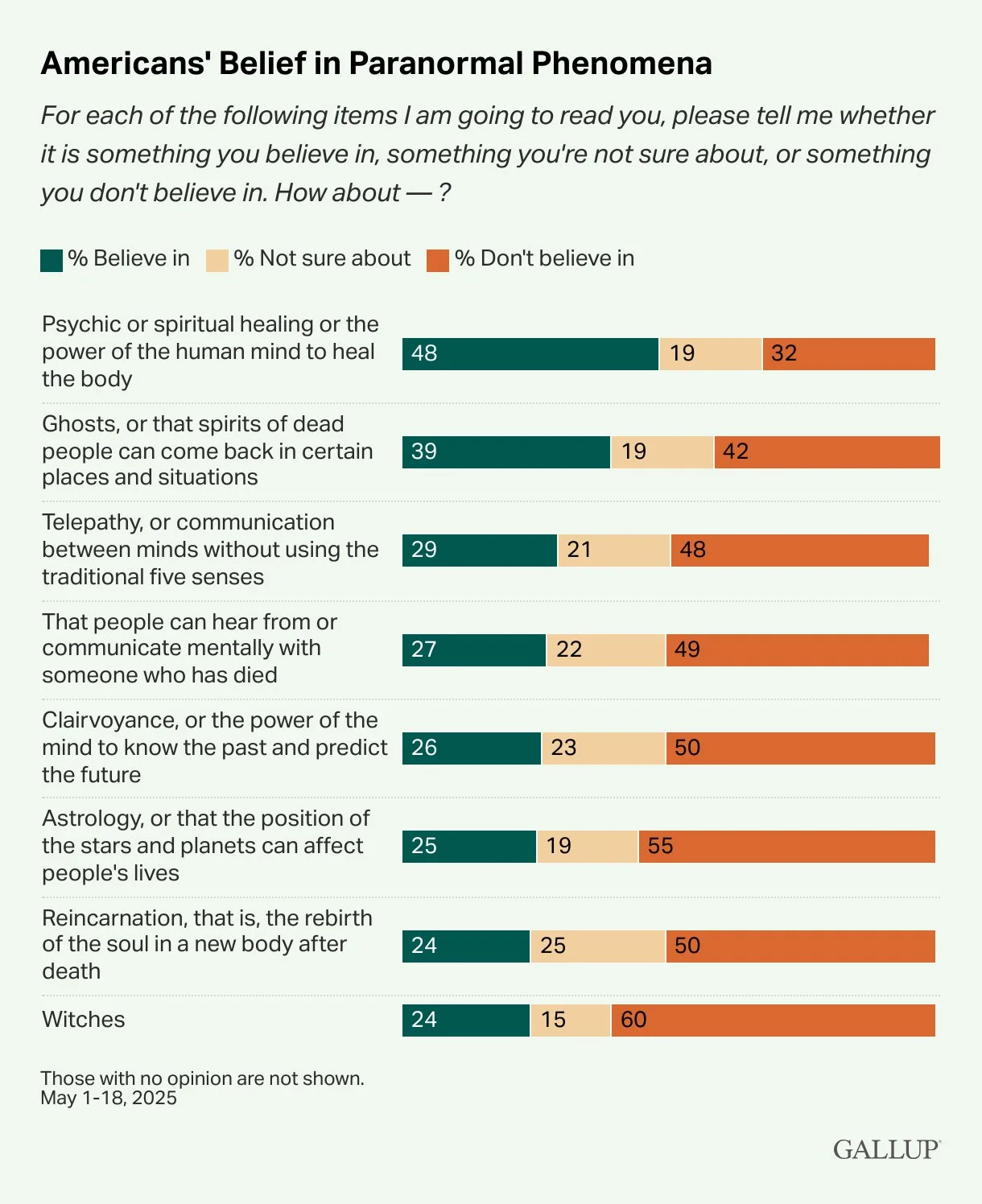
Meanwhile, belief is particularly low for witches (60% of Americans say “nope”), astrology (55% say no), and clairvoyance and reincarnation (both rejected by 50%).
It’s not just that people don’t believe — about 20% are unsure. Which begs the question: What makes someone open to believing in the paranormal in the first place?
To find patterns, Gallup looked at how beliefs cluster together. What they discovered is fascinating: the people who believe in one paranormal concept usually believe in several. One group — about 34% of Americans — tends to believe in at least three, often up to five. This is the "open" crowd. The other 66%? They're mostly skeptical, endorsing just one or none at all.
Even among skeptics, though, psychic healing stands out. A surprising 33% of non-believers still think there's something to it. Could it be that experiences with health, trauma, or faith leave even the most logical among us open to the unexplainable?
Demographics paint a revealing picture. Paranormal openness is more common among:
Women (40% open)
Political moderates and liberals (around 35–37%)
Infrequent churchgoers (40%)
College non-graduates (38%)
Meanwhile, skeptics are more often:
Men (28% open)
Conservatives (28%)
Weekly religious service attendees (22%)
College graduates (28%)
Interestingly, factors like age, religion, and political party didn’t create much of a divide — it's more about personal worldview and lifestyle than affiliation.
You might assume that religious people would be more likely to believe in the paranormal. But Gallup found the opposite. Weekly churchgoers were the most skeptical — 78% of them dismiss most paranormal beliefs. The less frequently people attend services, the more likely they are to be open to the unexplained. However, here's a twist: while church attendance has declined over the last 20 years, belief in the paranormal hasn’t gone up.
Whether you're a full-blown believer, a curious skeptic, or a die-hard debunker, the paranormal remains a cultural fascination. We may not agree on what’s “real,” but the idea of the unknown continues to haunt and inspire. One thing’s for sure: the truth is still out there.
