
BLOG: Historic North American Sea Serpent Sightings to Explore On National Sea Serpent Day
Not all monsters live in haunted houses! Some swim just under the waves. August 7th — National Sea Serpent Day — is for the beasts we rarely see but never stop imagining. In coves, creeks, lakes, and oceans across North America, long-bodied creatures have stirred panic, awe, and centuries of speculation. Legends aren’t born from nothing — especially not the kind told by sober sailors, stunned sheriffs, and terrified tourists. These are the top 10 North American sea serpent encounters that refused to sink quietly into myth.
Image from Wikipedia.
1. The Gloucester Sea Serpent (Massachusetts, 1817)
Location: Gloucester Harbor, Massachusetts
Date: August 1817
What Was Seen: A 60–100 foot serpent-like creature with a horse- or turtle-shaped head and a line of humps trailing behind
Who Saw It: Dozens of fishermen, townspeople, sea captains, and members of the Linnaean Society of New England
In the summer of 1817, the waters off Gloucester Harbor became the center of one of the most extraordinary sea serpent flaps in American history. Witnesses — including seasoned sailors, ship captains, and local townspeople — described a massive, dark-bodied creature swimming just offshore. Its head, shaped like a horse or turtle, rose several feet above the water, while its body moved in a smooth, undulating motion, creating waves like a ship under sail.
“The animal's head rose several feet out of the water, resembling that of a turtle or a horse... it moved with a majestic undulation.” – Captain Beach, eyewitness
The sighting gained so much attention that members of the Linnaean Society of New England conducted a formal investigation. After collecting over a hundred written affidavits and interviews, they boldly proposed the creature could be an entirely new species — naming it Scoliophis Atlanticus. Although no physical specimen was ever recovered, this remains one of the most thoroughly documented sea serpent encounters in early American history, with no evidence of exaggeration or hoax.
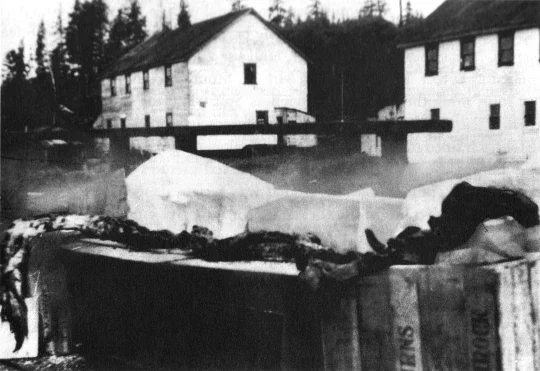
Image from Cryptid Wiki.
2. The Cadborosaurus (British Columbia, 1933)
Location: Naden Harbour, Haida Gwaii, British Columbia
Date: October 1933
What Was Seen: A 30-foot-long creature with a camel-like head, a horse-like mane, a serpentine body, and flippers
Who Saw It: Two whalers who discovered a partial carcass inside a sperm whale's stomach
In 1933, whalers working at a station in Naden Harbour made a discovery that stunned even seasoned seafarers. While processing a sperm whale, they found an unusual carcass in its stomach — a creature with a long, coiling body, flipper-like appendages, and a distinct head resembling a camel or horse, complete with a mane-like ridge. The carcass was partially digested, but photographs and written descriptions survive.
The creature matched generations of First Nations oral history, especially from the Haida and Nuu-chah-nulth peoples, who describe a long-bodied sea animal that had been seen in coastal waters for centuries. Nicknamed "Caddy", this Pacific sea serpent is now the subject of dozens of eyewitness accounts stretching from the 1800s to present day, particularly near the coasts of British Columbia, Washington, and Alaska.
Some researchers, including zoologists and cryptozoologists, believe the carcass may represent an unknown marine species, while skeptics suggest it could have been a misidentified shark or fetal whale.
Whatever the truth, the 1933 carcass remains one of the few physical pieces of evidence tied to any sea serpent legend — and Cadborosaurus continues to surface in sightings to this day.
Image from archival Art Folden film.
3. The Ogopogo (Lake Okanagan, BC, ongoing)
Location: Lake Okanagan, British Columbia
Date: First written report in 1872; mass sighting in 1926; notable footage in 1968
What Was Seen: A serpentine creature with 3–5 humps, measuring an estimated 40–50 feet long
Who Saw It: Tourists, locals, and motorists; filmed by Art Folden in 1968
Canada’s best-known lake monster, Ogopogo, is said to haunt the waters of Lake Okanagan, a deep, glacial lake stretching over 80 miles through British Columbia. Early Indigenous accounts — particularly from the Syilx (Okanagan) Nation — describe a powerful water spirit named N’ha-a-itk, which demanded offerings before people crossed the lake.
Modern sightings began as early as 1872, and in 1926, one of the most dramatic reports emerged when dozens of motorists parked along Okanagan Mission Beach claimed to see a long, dark creature moving through the water. In 1968, Art Folden filmed a brief but compelling clip showing a set of humps gliding across the lake’s surface.
“It looked like a log, then moved, and I saw humps. It wasn’t a boat or a wave.” – Art Folden
Eyewitnesses commonly describe the creature as undulating smoothly, creating a trail of v-shaped ripples, with a body that moves more like a snake than a fish. While skeptics point to logs, waves, or even otters, many sightings remain unexplained, and Ogopogo continues to draw attention from cryptozoologists and curious tourists alike.
Image from Wikipedia.
4. Lake Champlain’s Champ (New York/Vermont, ongoing)
Location: Lake Champlain, bordering New York and Vermont
Date: Famous photo taken in 1977; sightings date back to the 1800s
What Was Seen: A long-necked, gray-skinned creature, estimated at 20–30 feet in length, resembling a plesiosaur
Who Saw It: Sandra Mansi and her family, plus hundreds of other witnesses over the decades
Champ is one of the most enduring aquatic cryptids in North America. The creature allegedly inhabits Lake Champlain, a 125-mile-long glacial lake with deep, cold waters and numerous secluded inlets. In 1977, Sandra Mansi snapped what is now the most famous photo of the beast while vacationing with her family. The photo shows a serpentine neck and head rising from the water, eerily similar to the classic image of Scotland’s Nessie.
“We just froze,” Mansi said later. “It was real. It was alive. We watched it for several minutes.”
Though skeptics have questioned the photo’s authenticity, no definitive hoax has ever been proven. Meanwhile, local newspapers and cryptozoologists have documented over 300 sightings since the 19th century, many describing the same smooth, humped shape gliding just below the surface. The legend of Champ is so embedded in local culture that the lake is protected by law from harming any unknown species — just in case.
Image from ChatGPT.
5. The Tennessee Terror (Tennessee River, 1800s–early 1900s)
Location: Tennessee River, spanning eastern Tennessee into northern Alabama
Date: Sightings peaked between the late 1800s and early 1900s
What Was Seen: A 20–30 foot serpentine beast with a gaping mouth, dog-like face, and a thrashing, finned tail
Who Saw It: Riverboat crews, fishermen, and townsfolk — some of whom were said to suffer terrible fates
Along the winding waters of the Tennessee River, a creature known as the Tennessee Terror once struck fear into those who traveled the currents. Described as a massive, snake-bodied monster with glassy black eyes, a canine snout, and the ability to stir up violent whirlpools, the creature was blamed not only for its terrifying appearance — but for what happened after you saw it.
According to local lore, anyone who looked directly into its eyes was cursed — and would suffer misfortune, illness, or even death within a year.
Newspaper accounts from the Muscle Shoals and Decatur areas tell of boats being overturned and animals vanishing near the shoreline. A report from 1907 described the corpse of a local man who had recently spotted the creature — found days later with no wounds, his face “twisted in horror.”
Some cryptozoologists speculate the “Terror” could have been a giant eel, an unknown species of fish, or even a misidentified alligator — but none of that explains the string of bad luck and whispered stories that followed each encounter. By the 1930s, damming projects calmed the river’s chaos, and the Tennessee Terror vanished beneath concrete and turbines.
Image from Cryptid Wiki.
6. Raystown Ray (Pennsylvania, 1962–Present)
Location: Raystown Lake, Huntingdon County, Pennsylvania
Date: First sighting in 1962; reports continue into the 2000s
What Was Seen: A serpentine creature between 8 and 60 feet long, with multiple humps and a shadowy body just below the surface
Who Saw It: Campers, boaters, fishermen, and a paranormal TV crew
Nicknamed “Raystown Ray,” this alleged lake monster was first spotted in 1962, before the current manmade Raystown Lake was completed. The lake spans 8,300 acres, reaches 200 feet deep, and offers plenty of hiding space for something unusual. Eyewitnesses have reported large wakes with no boats, shadowy shapes under the water, and even photographic evidence of something massive just below the surface. In 2010, the Syfy show Fact or Faked investigated and concluded that a large creature in the lake was possible. Whether it's a giant carp or Pennsylvania’s own Nessie remains a mystery.
Image from YouTube.
7. Bear Lake Monster (Utah/Idaho, 1868–Present)
Location: Bear Lake, straddling the Utah–Idaho border
Date: First major reports in 1868 in the Deseret News
What Was Seen: An aquatic serpent-like creature with short legs, a horse-shaped head, and blazing eyes
Who Saw It: Early Mormon settlers, local residents, and Shoshone tribes, whose legends predate written accounts
In the summer of 1868, journalist Joseph C. Rich published an article claiming that settlers near Bear Lake had seen a massive, serpentine creature swimming at alarming speed through the clear mountain water. It had a long neck, a head like a horse, and even short limbs, giving it an appearance somewhere between a sea dragon and a prehistoric beast.
“The monster swam at great speed, diving and surfacing like a massive serpent.” – Joseph C. Rich
Though Rich later admitted to embellishing his reports, the Bear Lake Monster legend didn’t disappear. In fact, it tapped into older Shoshone oral tradition, which warned of a powerful creature inhabiting the lake long before settlers arrived. Even in modern times, occasional reports describe large disturbances in the water, unexplained wakes, or the flash of something massive just beneath the surface. Hoax or not, the story has endured for over 150 years — and Bear Lake’s deep, turquoise waters still hold more than a little mystery.
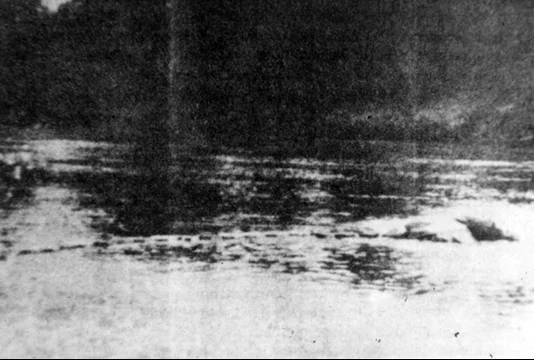
Image from Monstropedia.
8. White River Monster (Arkansas, 1915–1971)
Location: White River, near Newport, Arkansas
Date: Most famous sighting in 1937, with others in 1915 and 1971
What Was Seen: A gray, spiny-backed creature with a horn-like protrusion, described as “as wide as a car and three cars long”
Who Saw It: Farmers, fishermen, townspeople, and even the county sheriff
Reports of a strange, lumbering aquatic beast in Arkansas’s White River began as early as 1915, but the story exploded in 1937, when multiple witnesses — including law enforcement — claimed to see a massive creature surface near Newport. Descriptions varied slightly, but most agreed it was gray, rough-skinned, and had a row of spines or ridges down its back, along with a single horn or bone protrusion from its head.
One report described the creature as “wide as a car, and three cars long,” creating huge boils of water as it moved.
The sightings returned again in 1971, prompting enough concern that Arkansas passed legislation declaring the White River Monster Refuge, making it illegal to harm or harass the creature. Explanations have ranged from a massive sturgeon to a wayward manatee or even an elephant seal, but none quite match the combination of size, shape, and behavior described by witnesses. To this day, “Whitey” remains one of the most legally protected monsters in America.
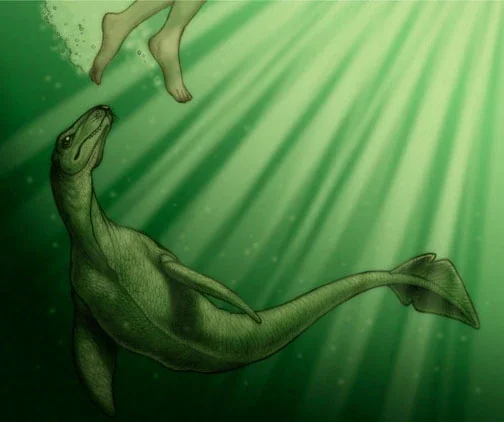
Image from Cryptid Wiki.
9. Altamaha-ha (Georgia, ongoing)
Location: Altamaha River, near Darien, Georgia
Date: Rooted in centuries-old Creek lore; notable modern sightings in 2002 and 2010
What Was Seen: A 20–30 foot creature with a crocodilian or alligator-like head and an undulating, serpentine body
Who Saw It: Former newspaper publisher Andy Genzoli, local fishermen, and tourists
Known locally as the Altamaha-ha or simply “Altie,” this cryptid has been part of Muscogee (Creek) oral history for generations. Said to inhabit the murky bends and estuaries near the Georgia coast, the creature is often described as grayish-green, with bony ridges, flipper-like appendages, and a gator-shaped head. It’s typically spotted in the Altamaha River and its swamps, especially near Darien.
In 2002, former newspaper publisher Andy Genzoli reported seeing something large and reptilian cutting through the water. Then in 2010, a group of tourists described a chilling encounter:
“It moved like a snake, not a dolphin. The water boiled around it.” – Unidentified witness, 2010
Some skeptics claim the creature is likely a manatee or gar, but others insist the shape, movement, and powerful wake rule those out. Despite the lack of a clear photograph, sightings of Altamaha-ha continue to surface — making it one of the Deep South’s most persistent aquatic mysteries.
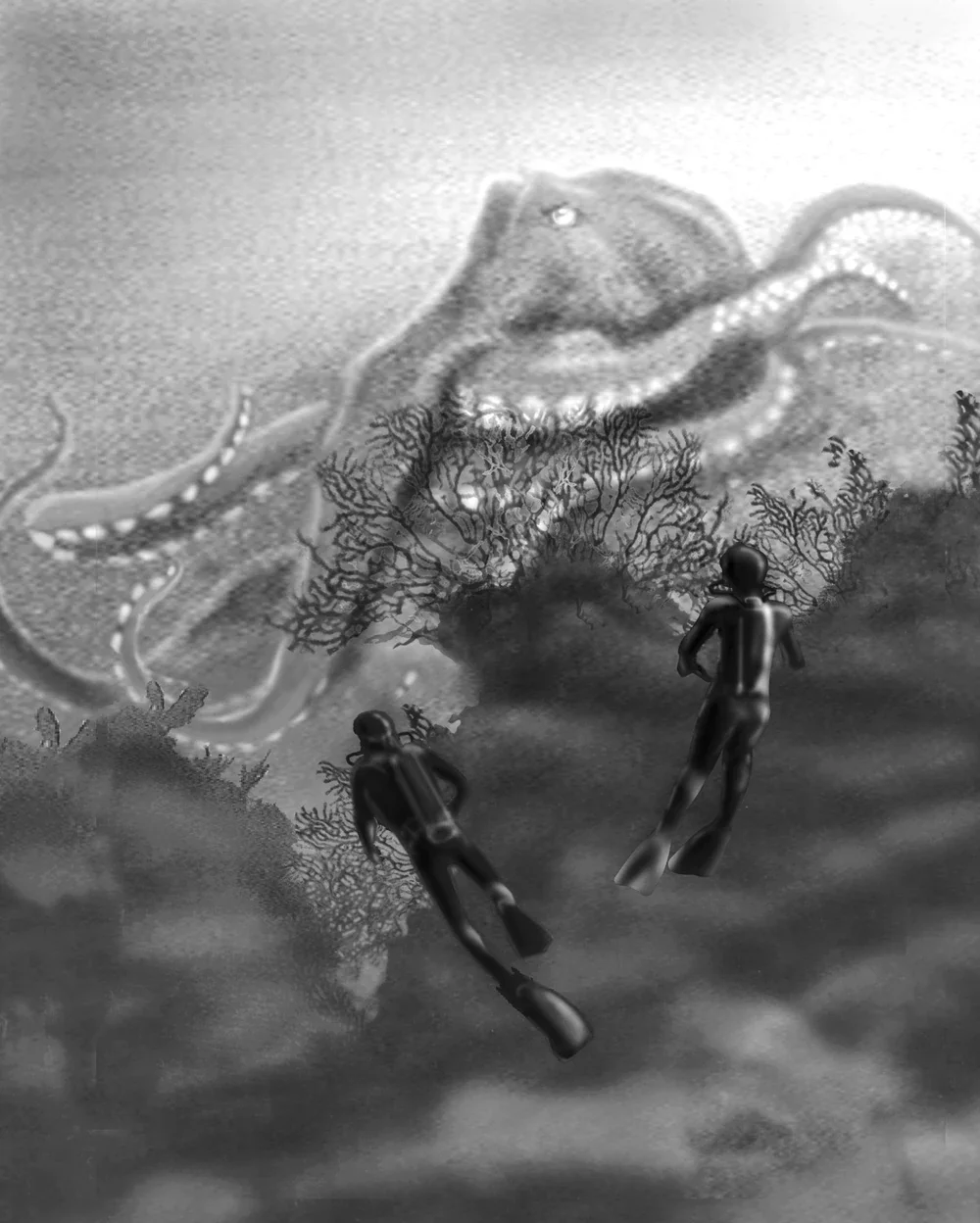
Image by William Rebsamen.
10. Lusca (Bahamas & Florida Keys, historical)
Location: Blue Holes of the Bahamas and coastal waters near the Florida Keys
Date: Reported since the 1700s; sightings continue in modern diving reports
What Was Seen: A massive part-octopus, part-serpent hybrid, often said to be over 75 feet long, with tentacles and a serpentine torso
Who Saw It: Early sailors, islanders, deep-sea divers, and underwater cave explorers
The Lusca is the Caribbean’s legendary sea monster, feared for centuries and rumored to dwell deep within the Blue Holes of the Bahamas — submerged limestone caverns that plunge hundreds of feet below the ocean floor. Witnesses have described a gargantuan, tentacled creature capable of pulling swimmers under and smashing small boats against rocks. Some accounts describe it as a hybrid between a giant octopus and a sea serpent, with incredible strength and a terrifying size. It’s often blamed for disappearances of divers, fishermen, and even boats — swallowed without a trace.
Modern cave divers have reported seeing shadowy forms, tentacle-like movements, and sudden violent currents near underwater entrances. Though skeptics suggest giant octopuses or undersea vortexes may be responsible, no one has ever captured definitive footage of the Lusca. Still, it remains one of the most widely feared and enduring marine legends in the Caribbean — the region’s own version of the kraken.
So many sightings. So many descriptions. So little proof. And yet, somewhere between imagination and evidence, something slithers. Maybe they’re misidentified fish, relics of the Ice Age, or mass hallucinations. But if you’ve ever watched the water ripple with no wind, or seen something vanish beneath the surface too fast for explanation, you know the feeling: even if you can’t see it, something’s in the water!


